Some chess games are remembered because they decided championships.
Others survive because they changed the way people think about the game.
And then there is the Immortal Game.
Played between Adolf Anderssen and Lionel Kieseritzky in London in 1851, it has almost everything associated with romantic attacking chess: a King's Gambit, an exposed king, pieces hanging everywhere, two sacrificed rooks, and finally a queen offered purely to force checkmate.
More than 170 years later, players still study it.
Not because every move was perfect.
Because the ideas are unforgettable.
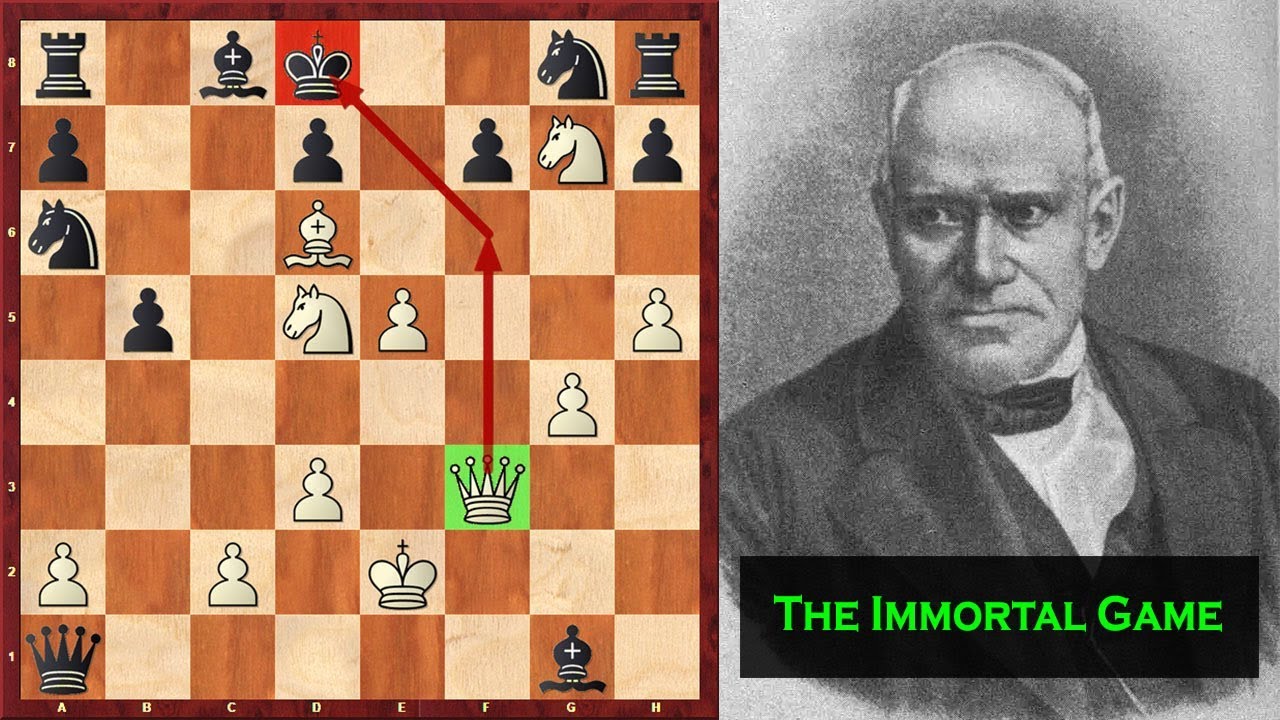
What is the Immortal Game?
The Immortal Game was an informal chess game played between Adolf Anderssen and Lionel Kieseritzky in London in 1851.
Anderssen was one of the strongest players of his era and had won the major London tournament held that year.
Kieseritzky was a strong master based in Paris and a well-known figure at the famous Café de la Régence.
But this particular game would outlive both players.
Anderssen sacrificed a bishop, both rooks, and eventually his queen before delivering checkmate with his remaining minor pieces.
Before discussing the ideas, play through the complete game.
Adolf Anderssen — Lionel Kieseritzky
The Immortal Game · 1851.06.21 · 1-0
0 / 45
- 1.
- 2.
- 3.
- 4.
- 5.
- 6.
- 7.
- 8.
- 9.
- 10.
- 11.
- 12.
- 13.
- 14.
- 15.
- 16.
- 17.
- 18.
- 19.
- 20.
- 21.
- 22.
- 23.
The game lasts only 23 moves.
Yet by the end of it, most of White's most valuable pieces are gone.
That is precisely the point.
It begins with the King's Gambit
The first critical decision arrives immediately:
1.e4 e5 2.f4
Anderssen offers the f-pawn.
This is the King's Gambit, one of the most famous attacking openings in chess history.
After:
2...exf4
Black accepts the pawn.
White has voluntarily given material away in exchange for something less visible: rapid development, open lines, and attacking chances.
That gives us the first lesson of the game:
A good sacrifice does not simply lose material. It buys something.
That "something" might be:
- development,
- an open file,
- control of important squares,
- exposure of the enemy king,
- removal of a defender,
- or simply time.
If you sacrifice a piece and cannot explain what you receive in return, there is a good chance it was not really a sacrifice.
It was just a blunder.
Anderssen gives up castling almost immediately
After:
3.Bc4 Qh4+
Anderssen plays:
4.Kf1
White's king has moved on move four.
Castling is gone.
That sounds terrible according to one of the first rules taught to new chess players: castle early and protect your king.
But chess principles are not laws.
King safety depends not only on where your king stands, but also on whether the opponent can actually attack it.
Black's queen has entered the game very early while most of Black's other pieces remain undeveloped.
And that queen will soon spend several moves travelling around the board.
The hidden price of moving the queen repeatedly
Look at the journey of Black's queen:
3...Qh4+
6...Qh6
8...Qg5
12...Qg6
13...Qg5
The queen is active, but activity is not the same as development.
Every queen move consumes a tempo.
During that time, White can bring more pieces toward the centre and the black king.
This distinction becomes increasingly important as the position opens.
A rook sitting on a8 may theoretically be worth five points.
But if it cannot influence the position, those five points do not help defend the king.
Chess pieces have theoretical values.
Positions determine their real values.
11.Rg1 — development with tempo
After:
10.g4 Nf6
Anderssen plays:
11.Rg1
The rook develops while attacking Black's queen.
Black responds with:
11...cxb5
and captures the bishop on b5.
White has now sacrificed even more material.
But Anderssen does not rush to recover it.
Instead:
12.h4
followed by:
13.h5
keeps attacking the queen.
Black is repeatedly forced to react.
That introduces one of the most important concepts in attacking chess:
Initiative can temporarily be worth more than material
Imagine that you win a rook, but doing so gives your opponent three consecutive forcing moves against your king.
Did you really have time to enjoy the rook?
This is why strong attacks often look strange when evaluated only through material.
The attacker gives something away.
The defender takes it.
But every capture costs a move.
And sometimes the move is more valuable than the piece.
Checks, captures, and direct threats are powerful because they reduce the opponent's choices.
The fewer reasonable responses your opponent has, the easier the position becomes to calculate.
The position that made the game immortal
After:
17.Nd5 Qxb2
we reach one of the most important positions in the game.
Try playing it from here before reading further.
Adolf Anderssen — Lionel Kieseritzky
The Immortal Game — First Critical Position · 1851.06.21 · 1-0
0 / 11
- 18.
- 19.
- 20.
- 21.
- 22.
- 23.
White to move.
Before continuing, consider what you would play.
Black is already threatening the rook on a1.
White's rook on g1 is also attacked.
Most players would instinctively try to save material.
Anderssen does something completely different.
18.Bd6! — ignore the rooks
He plays:
18.Bd6!
The move is beautiful partly because it does not look spectacular.
It is not a check.
It does not capture anything.
And it does not save either rook.
Black takes the first:
18...Bxg1
Anderssen continues:
19.e5
Then Black takes the second:
19...Qxa1+
Both white rooks are now gone.
Materially, the position looks ridiculous.
Black has collected an enormous amount of material.
But there is another way to count a chess position.
Instead of asking:
How many pieces do I have?
Ask:
How many pieces can actually participate in the important part of the board?
Black has plenty of material.
Much of it is useless.
White has fewer pieces.
Almost every one of them is attacking the king.
Material only matters if you survive long enough to use it
Imagine a position where you have an extra queen but your opponent has checkmate in one.
How valuable is your extra queen?
Zero.
That extreme example reveals something fundamental about chess.
Material value is conditional.
A rook is worth approximately five pawns when the rook has time to matter.
A queen is worth approximately nine pawns when the queen can participate.
If the game ends before that happens, theoretical material values become irrelevant.
The Immortal Game pushes this principle almost to absurdity.
Black keeps collecting material.
White keeps collecting tempi.
Only one of those resources eventually matters.
The final attack begins
After:
19...Qxa1+
Anderssen must respond to check:
20.Ke2
Black now plays:
20...Na6
Apparently defending against one of White's mating ideas.
Then comes:
21.Nxg7+
The knight joins the attack with check.
Black's king moves:
21...Kd8
And now we reach the position that every tactical player should remember.
Can you find Anderssen's final combination?
White to move.
Do not immediately read the solution.
Use the interactive board and try to calculate it first.
Adolf Anderssen — Lionel Kieseritzky
The Immortal Game — Queen Sacrifice · 1851.06.21 · 1-0
0 / 3
- 22.
- 23.
White has a queen.
Black's king is trapped.
The question is not:
How can I save my queen?
The question is:
Which black piece prevents checkmate?
The answer is the knight on g8.
It protects e7.
Anderssen therefore plays one of the most famous moves in chess history:
22.Qf6+!
The queen moves directly into danger:
22.Qf6+!
Black captures:
22...Nxf6
The queen disappears.
But something much more important has happened.
The knight that defended e7 has been dragged away from g8.
Now Anderssen plays:
23.Be7#
Checkmate.
White's queen is gone.
Both rooks are gone.
One bishop is gone.
None of it matters.
The black king has no legal move.
The queen sacrifice is actually a deflection tactic
It is tempting to remember the Immortal Game as:
"That game where Anderssen sacrificed his queen."
But that misses the most useful lesson.
22.Qf6+ works because of deflection.
A defender performs an important job.
You force that defender somewhere else.
Then you exploit what it was protecting.
The pattern is:
Knight on g8 → protects e7

Qf6+ → forces the knight away

...Nxf6 → e7 loses its defender

Be7# → checkmate
The spectacular part is the queen sacrifice.
The reusable chess pattern is removing a defender.
And that pattern appears constantly in ordinary games.
You do not need to sacrifice a queen.
Sometimes you sacrifice a pawn to drag a defender away.
Sometimes you exchange a bishop.
Sometimes a check forces a rook away from the back rank.
The Immortal Game simply demonstrates the idea in the most memorable possible way.
Why couldn't Black use all the extra material?
Look again at the final position.
Black still has major pieces on the board.
But they are badly coordinated.
The queen has travelled all the way to a1.
Other pieces cannot reach the king quickly enough.
Meanwhile, White's remaining pieces work together perfectly.
That gives us another useful attacking rule:
Count useful pieces, not pieces.
Suppose five pieces technically remain on your side.
If three of them cannot participate in the battle around your king, you may effectively be defending with only two.
An attack involving three coordinated pieces can therefore overwhelm an army that appears much larger on paper.
Three tactical lessons from the Immortal Game
1. Count attackers and defenders
Do not evaluate an attack only by counting material.
Count how many pieces can actually reach the critical area of the board.
Before accepting a sacrifice, ask:
What happens after I take it?
If your opponent gains two forcing moves and another attacker enters the position, that "free" piece may be extremely expensive.
2. Identify what every defender is protecting
When attacking, do not only search for pieces you can capture.
Look for jobs.
Ask:
- Which piece protects the mating square?
- Which piece blocks an important file?
- Which piece prevents my next check?
- Which defender is overloaded?
- Can I force that defender to move?
That reasoning leads directly to 22.Qf6+.
The knight on g8 has a job.
Anderssen removes it from that job.
3. Calculate forcing moves first
Long combinations often look impossible when viewed from the beginning.
They become much easier when many moves are forced.
During tactical calculation, investigate:
- Checks
- Forcing captures
- Direct threats
This does not mean that every check is good.
It means checks dramatically reduce the opponent's available replies, making calculation easier.
Qf6+ is especially powerful because Black cannot simply ignore the queen sacrifice.
The king is in check.
Something must happen immediately.
The deeper lesson: chess piece values are dynamic
Beginners often learn approximate values:
| Piece | Approximate value |
|---|---|
| Pawn | 1 |
| Knight | 3 |
| Bishop | 3 |
| Rook | 5 |
| Queen | 9 |
These numbers are useful.
But they are not physical laws.
A trapped rook may contribute almost nothing.
A bishop controlling a mating square may decide the entire game.
A passed pawn one square from promotion can be worth more than a minor piece.
And sometimes one tempo is worth enough to justify sacrificing material.
The Immortal Game is an extreme example of this principle.
White eventually owns dramatically less material than Black.
But White owns something more important:
the next forcing move.
Was the Immortal Game perfect chess?
No.
And that actually makes it more useful.
Modern analysis has found improvements for both sides, and several famous moves are not necessarily the objectively strongest choices available.
The game comes from the Romantic era of chess, when open positions, gambits, rapid development, sacrifices, and direct attacks were especially prominent.
Players were often much more willing to enter positions that modern elite players might avoid.
But a chess game does not need to contain 23 engine-perfect moves to teach something valuable.
The Immortal Game survives because its strategic and tactical ideas are extraordinarily clear:
development matters.
time matters.
coordination matters.
king safety matters.
And material matters only while the game continues.
A tactical exercise from the game
Go back to the position after:
21...Kd8
and hide the continuation.
Then answer three questions before moving a piece:
- Which square could White use to deliver checkmate?
- Which black piece currently protects that square?
- Can White force that piece away with check?
If those questions lead you to 22.Qf6+, you have understood much more than the move itself.
You have identified the pattern.
That distinction matters.
Memorising Qf6+ is chess trivia.
Recognising deflection of a critical defender in your own game is chess improvement.
Why is it called the Immortal Game?
The game was published soon after it was played and became famous throughout the chess world.
Several years later, the name "Immortal Game" became associated with Anderssen's extraordinary victory.
The title proved remarkably accurate.
More than a century and a half later, the game is still reproduced in chess books, lessons, videos, databases, and tactical courses.
Immortal Game FAQ
Who played the Immortal Game?
The Immortal Game was played between Adolf Anderssen, playing White, and Lionel Kieseritzky, playing Black, in London in 1851.
Who won the Immortal Game?
Adolf Anderssen won with a mating attack ending in the famous continuation:
22.Qf6+ Nxf6 23.Be7#
What opening was played in the Immortal Game?
The game began with the King's Gambit Accepted:
1.e4 e5 2.f4 exf4
The King's Gambit gives up a pawn in exchange for rapid development and attacking possibilities.
Why is the Immortal Game famous?
It is famous for Anderssen's extraordinary attacking combination.
White sacrifices a bishop, both rooks, and finally the queen before delivering checkmate with the remaining minor pieces.
When was the Immortal Game played?
Anderssen and Kieseritzky played the game in London in 1851 during the period of the famous London international chess tournament.
Is the Immortal Game considered perfect today?
No.
Modern analysis has identified stronger alternatives in several positions.
Its importance comes from its tactical beauty and its exceptionally clear demonstration of development, initiative, piece coordination, sacrifice, and king safety.
A game worth remembering
You will probably never reproduce the Immortal Game move for move.
You should not try to.
What you can reproduce are its ideas.
Develop pieces with purpose.
Notice when initiative is more urgent than material.
Identify the defender holding a position together.
Look at forcing moves before quiet ones.
And when considering a sacrifice, calculate the resulting position instead of stopping your evaluation at the material count.
That is why a 23-move casual game played in London in 1851 is still studied today.
The pieces disappeared.
The pattern survived.